






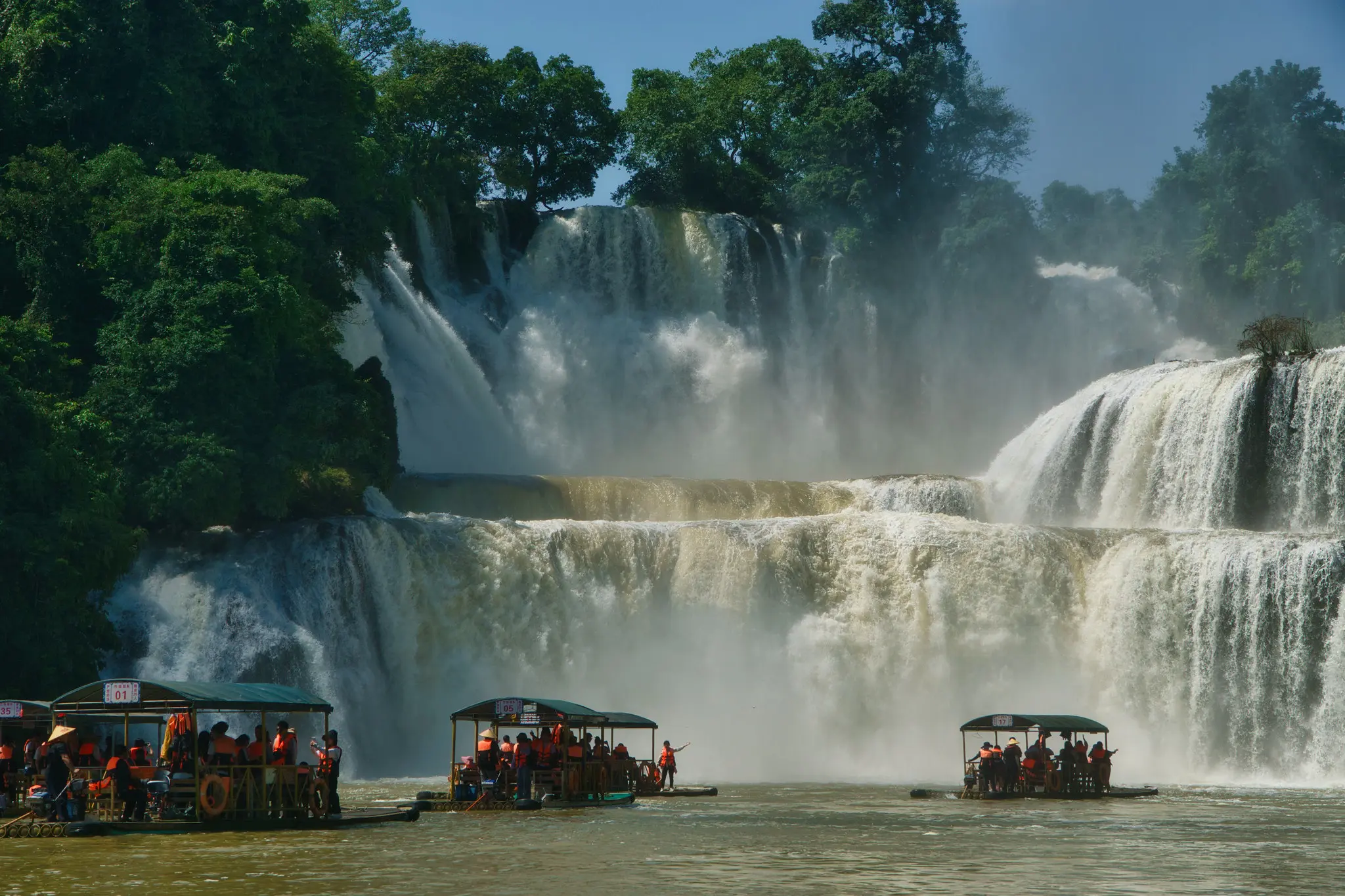
Tucked away on Vietnam’s northern border, Ban Gioc Waterfall in Cao Bang has breathtaking cascades that feel both wild and peaceful at the same time.
While it is technically easy to reach Ban Gioc, the combination of long journey times, infrequent schedules, and the challenging final stretch makes this option significantly more stressful than it’s worth for most travelers. Before you hit the road, here’s everything you should know to experience Ban Gioc Waterfalls at its best.
Introducing Ban Gioc Waterfall (Thác Bản Giốc)
Ban Gioc Waterfalls or Thác Bản Giốc in Vietnamese is located in the Trung Khanh district of Cao Bang Province in northeastern Vietnam, roughly 340 km from Hanoi. It sits directly on the international border between Vietnam and China, with the Quay Son River serving as the natural dividing line. Half of the waterfall belongs to Vietnam; the other half belongs to China, where it is known as Détian Falls.
The falls cascade over three tiers, reaching a height of approximately 30 meters and stretching more than 300 meters wide, making it the widest waterfall in Vietnam and one of the largest cross-border waterfalls in the world. Surrounded by karst limestone peaks, lush jungle, and terraced rice fields, Ban Gioc is set within the Non Nuoc Cao Bang UNESCO Global Geopark, which is a landscape of extraordinary geological and cultural significance.
Opening time: Daily from 7:30 AM to 5:30 PM

Ban Gioc Waterfall looks even more majestic up close (Source: Internet)
How to get to Ban Gioc Waterfalls?
Ban Gioc is remote and that’s part of both its appeal and challenge. The waterfall sits approximately 340 km from Hanoi and typically takes 7 to 8, depending on your route and stops. For travelers coming from Hanoi, there are two options that balance safety and convenience.
Option 1: Hire a private car from Hanoi to Ban Gioc
If comfort and flexibility matter most, a private car is hands down the best way to get to Ban Gioc, especially for first-time visitors, families, or anyone traveling with luggage. You get door-to-door service, no fixed schedule, and full control over your itinerary. It’s more expensive, but the convenience is hard to beat.
Most travelers book a 7-seater sedan or minivan from Hanoi for a 2-day, 1-night trip. The driver handles everything from navigation, waiting time at the waterfall, to the return journey, so you can just relax and enjoy the ride.
Private car hire from Hanoi to Ban Gioc and back typically costs between 3,500,000–5,500,000 VND ($140–$220 USD) for a round trip, depending on vehicle size and the agency.
Tips: It is advisable to book a driver who is familiar with the Cao Bang roads specifically since mountain driving in this region requires much experience.

TSA’s tour to Cao Bang
Option 2: Join an organized tour to Cao Bang
If you prefer a well-organized trip with local insights, joining a guided tour from Hanoi is a solid choice. Many operators offer 2- or 3-day packages to Ban Gioc that bundle everything together, often including stops at highlights like Nguom Ngao Cave, Khuoi Ky Stone Village, and Pac Bo Cave for a more complete Cao Bang experience.
RECOMMENDED TOUR
Explore the breathtaking beauty of Cao Bang with our 9-day Through the Hidden Gems of Northern Vietnam tour.
The best time to visit Ban Gioc Waterfalls
Timing your trip to Ban Gioc can make a significant difference in what you experience since the waterfall changes dramatically between seasons.
| Period | Months | Water Flow | Rating |
|---|---|---|---|
| Peak Water Season | Sep – Oct | Maximum with dramatic and full-width cascades | Best time |
| Spring | Mar – May | Moderate with good flow, clear skies, great for hiking | Recommended |
| Dry Season | Nov – Feb | Lower natural flow, supplemented by dam releases | Acceptable |
| Rainy Season | Jun – Aug | Very high and can be dangerous to travel | Not recommended |
And here’s something many travelers don’t realize: it’s not just about the season. Even within a single day, there are specific hours when the waterfall releases more water, which can dramatically change how impressive it looks.
Peak water season: September to October
This is widely considered the absolute best time to visit Ban Gioc. After summer rains, the falls are at their fullest and most powerful, with water surging across their widest span. At the same time, nearby rice fields turn golden, creating Ban Gioc’s most iconic scenery that appears in most travel photography.

September to October is the best time to travel to Ban Gioc waterfalls. (Source: Internet)

November to February Ban Gioc offers misty calm waterfall views. (Source: Internet)
Dry season: November to February
During the dry season, the natural water flow slows considerably. However, local operators release water from an upstream dam at set times during the day, which allows visitors to still witness a reasonably full waterfall. The weather is cooler and often misty, which can create an atmospheric and almost ethereal quality to the falls.
Best times of day to visit Ban Gioc Waterfalls
Beyond seasonal timing, the time of day matters too. Early morning when the site opens at 7:30 AM is considered the quietest period, with soft light and minimal crowds for photography.
Around midday, the upstream dam is usually released, making the falls look fuller and more powerful. For the best experience, come early for photos, then return around 11:30 AM–1 PM to see the waterfall at its peak flow.
TRAVEL TIPS
Plan your journey perfectly! Learn more about the Best time to visit Vietnam: specific months or year-round.
Rainy season: June to August
The waterfall is extremely powerful during the peak rainy months, but the trade-off is significant: heavy rain can make the mountain roads dangerous, cause flash flooding, and result in gray, overcast conditions that don’t photograph well. If you visit during this period, check road conditions carefully before setting out and build extra time into your schedule.
Holiday periods to avoid
Ban Gioc is popular with Vietnamese domestic tourists, particularly during national holidays. The Tết (Lunar New Year) period in late January or February, the April 30th–May 1st holiday, and the September 2nd National Day holiday all bring significantly larger crowds to the falls. Weekends are also noticeably busier than weekdays. If your dates are flexible, aim for a Tuesday to Thursday visit.
The entry fee to Ban Gioc Waterfalls
Ban Gioc Waterfalls is a ticketed site managed by local authorities, with a staffed entrance gate and a small kiosk where you purchase ticket before entry.
Current fees (Updated 2026):
- Adult entrance: 45,000 VND (~$1.80 USD)
- Children: Reduced or free (depending on age)
- Bamboo raft ride: 50,000 VND (~$2 USD) per person
Important note: Cash only, no ATMs nearby
Ban Gioc is in a very remote area, and there are no ATMs anywhere near the waterfall. Card payments are not accepted at the entrance, at raft operators, or at most restaurants and guesthouses in the surrounding area. Therefore, withdraw enough Vietnamese Dong for your entire visit.
Bamboo raft experience at Ban Gioc

Bamboo raft ride at Ban Gioc for close and misty waterfall views. (Source: Internet)
One of the best things to do at Ban Gioc is hopping on a bamboo raft. From the lower viewing area, local operators take you out onto the Quay Son River and right up close to the falls, which is close enough to feel the mist and hear the water crashing above you.
The ride lasts around 10–15 minutes and even passes along the Vietnam-China border. You’ll spot the difference right away: Vietnamese rafts have blue canopies, while the Chinese side uses green. From the water, you get a stunning panoramic view of the entire waterfall framed by limestone mountains.
Be ready to get wet, especially in peak water season. So, bring a waterproof bag for your phone or camera. It’s safe and guided, but definitely more of a splashy, up-close experience than a calm boat ride.
What to wear and bring at Ban Gioc Waterfalls
Ban Gioc’s remote location means there are no convenience stores to save you if you forget the basics, so packing thoughtfully would make it a smooth, comfortable and safe trip.
- Waterproof lifevest is essential for those who takes the bamboo raft.
- Wear comfortable closed toe shoes because the paths can be slippery especially in wet conditions.
- Bring a waterproof bag to protect your phone camera and electronics.
- Use sunscreen and a hat since you will be exposed to strong sun between viewpoints.
- Carry enough Vietnamese Dong in cash as there are no ATMs near the falls.
- Pack insect repellent for mosquitoes in forested and cave areas.
- Carry a reusable water bottle to stay hydrated and reduce plastic waste.
RECOMMENDED TOUR
Conquer the majestic mountain passes with our Sensational Ha Giang Loops 10 Days package.
Must-visit places and where to stay around Ban Gioc Waterfalls
Ban Gioc is the headline act, but Cao Bang Province has a supporting cast of remarkable experiences that reward travelers who stay longer than a single day.

Explore Nguom Ngao Cave near Ban Gioc. (Source: Internet)
Nguom Ngao Cave
Just 3 km away, this massive cave stretches over 2 km through limestone mountains. Inside, towering stalactites and vast chambers feel almost cathedral-like. It stays cool year-round, making it a refreshing escape from the heat. Entrance is around 40,000–60,000 VND, usually with a local guide.
Khuoi Ky Stone Village
A unique Tay ethnic village built entirely from stone. The centuries-old houses, with limestone walls and roofs, create a setting unlike anywhere else in Vietnam. Together with home-cooked meals and peaceful vibe, homestays at Khuoi Ky Village are great choices if you’re looking to experience life beyond the waterfall.

Traditional Tay stone village with unique homes. (Source: Internet)

Cao Bang with varied hotels and convenient base for Ban Gioc visits. (Source: Internet)
Cao Bang City
For more comfort and a wider range of options, stay in Cao Bang city (about 2 hours away) and visit Ban Gioc on a day trip. Accommodation ranges from budget stays (~400,000 VND) to mid-range hotels (800,000–1,200,000 VND), making it a convenient base for exploring the region.
Book in advance for September–October visits
During the peak water season, accommodation near the waterfall fills up quickly, particularly on weekends. If you’re visiting in September or October, book at least 2–3 weeks ahead yourself or find a local tour operator in Hanoi to arrange this as part of a package deal.
Important notes for a visit to Ban Gioc and Cao Bang
Visiting Ban Gioc requires a degree of preparation that a trip to more established tourist destinations doesn’t. Keep the following in mind before and during your visit.
- Mountain roads: Getting there involves narrow, winding mountain roads, sharp turns, steep slopes, and occasional rough patches.
- Limited mobile signal: Signal can drop out completely in many areas. Download offline maps in advance and save key locations like your hotel and important contacts before you go.
- Remote healthcare: The nearest proper hospital is in Cao Bang city, about 2 hours away. There are no medical facilities near the falls, so bring essential medications and a basic first aid kit.
- Respect local communities: This region is home to Tay and Nung communities with deep-rooted traditions. Dress modestly, ask before taking photos, and support local businesses when you can.
Ban Gioc isn’t the easiest place to reach and that’s exactly what makes it special. The journey takes effort, but what you get in return is one of the most breathtaking landscapes in Vietnam, far from the crowds and noise of typical tourist spots.
With the right timing, a bit of preparation, and realistic expectations, you’ll experience one of Vietnam’s most stunning natural wonders at its best. Do it right, and Ban Gioc won’t just be a stop on your itinerary but be one of the most memorable highlights of your trip. Let Travel Sense Asia help you craft the perfect Northern adventure!
Frequently Asked Questions about Ban Gioc Waterfall
How do you get to Ban Gioc Waterfall?
Travel from Hanoi by bus, private car, motorbike, or guided tour to Cao Bang, then continue about 2 hours to the falls. Private cars and tours are the most convenient options.
How much does it cost to visit Ban Gioc Waterfall?
Entrance is around 45,000 VND per adult. Extras like the bamboo raft ride (~50,000 VND) and parking come at a small additional cost.
Can you swim at Ban Gioc Waterfall?
Swimming isn’t allowed at the main falls due to safety and border restrictions. You can get close to the water via the bamboo raft instead.
Is Ban Gioc worth visiting?
Absolutely. Its scale, natural setting, and unique location on the Vietnam–China border make it one of the most impressive waterfalls in Vietnam.