




When travelers search for “Vietnam golden season,” the internet is immediately filled with spectacular images of yellow rice terraces stretching across high mountains. Destinations like Sapa, Ha Giang, and Mu Cang Chai have become famous worldwide for their breathtaking harvest landscapes.
However, looking at the golden fields from afar is only half the experience. The true values of the harvest season in Vietnam lives in the soul of the ethnic minority villages. For the local people, the moment the rice turns yellow is the most important time of the year. It is a time to thank the heavens, honor the ancestors, and share the joy of a good crop.
From the cool mountains of the North to the majestic Central Highlands, let us guide you through the most unique and beautiful harvest celebrations in Vietnam.
“New rice celebration”: Thanksgiving of the ethnic minorities
For ethnic minority groups living in remote areas, growing rice on steep mountain slopes or dry hills is incredibly difficult. They cannot use modern machines. Everything is done by hand, and their success depends entirely on nature. If the rain falls at the right time, they have enough food for the whole family. If the weather is harsh, life becomes a struggle.
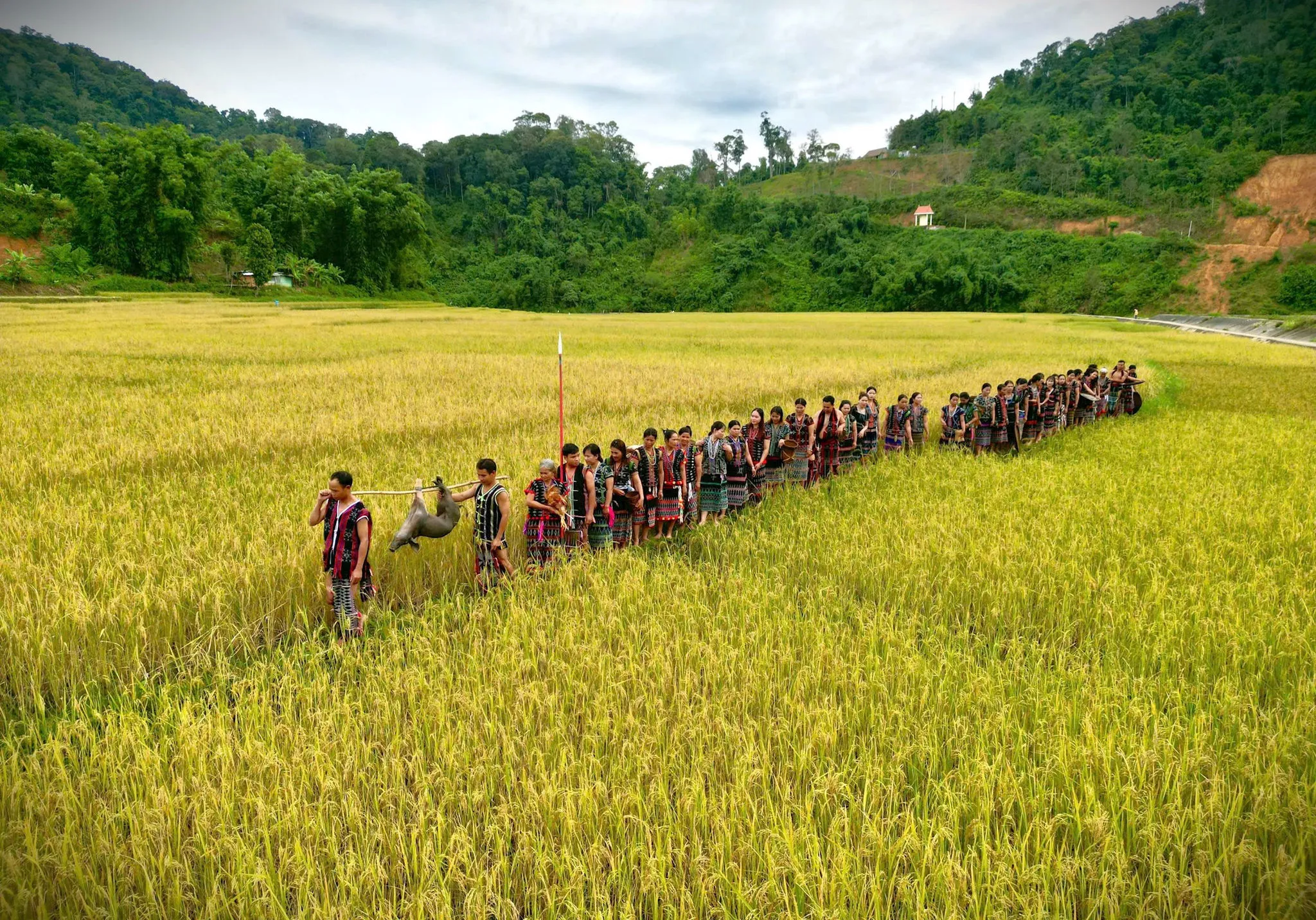
Because of this deep reliance on nature, the local people believe that they do not grow the rice alone. They believe that the Gods of Agriculture, such as the Rain God, the Earth God, and the Rice Goddess, protect their fields. Therefore, when autumn arrives and the green valleys turn into a golden sea, the villagers cannot just cut the rice and eat it. They must perform sacred rituals. They harvest the very first grains, cook the “new rice,” and offer it to the heavens and their ancestors to say “Thank you.”
For travelers seeking a meaningful cultural journey, witnessing these harvest celebrations is a beautiful experience. It is a return to a simpler, more connected way of life. You will smell the sweet smoke of cooking fires, hear the rhythmic sound of traditional music, and taste the freshest food straight from the earth. Let us explore five unique harvest celebrations that you can experience during the golden season.

The H’Mong people’s harvest: Eating the first golden grains (Sapa)
If you travel to the famous rice terraces of Sapa (Lao Cai Province) in September, you will see the H’Mong people harvesting their crops. The H’Mong are one of the largest and most recognizable ethnic groups in the North, famous for their vibrant, colorful embroidered clothing and their strong farming skills.
A celebration right in the golden fields
The H’Mong celebration is exactly what you imagine when you think of a “harvest festival.” It happens exactly when the rice terraces are at their most yellow and beautiful. When the village elder decides that the rice is perfectly ripe, the whole family goes out to the fields. The golden terraces are filled with the sounds of laughter and the swift cutting of sickles.
The H’Mong do not wait until all the rice is cut to celebrate. On the very first day of the harvest, they bring a small bundle of the freshly cut yellow rice back to their wooden houses. They quickly dry the rice, remove the husks, and cook the very first pot of new rice. This rice is then placed on the family altar. The head of the family will light incense and invite the spirits of their ancestors to come back, enjoy the new rice, and bless the family with health and a full storage bin.

EXPERIENCE SAPA AUTHENTICALLY
Immerse yourself in the breathtaking terraces and rich local culture with our signature Sapa Tours.
Kin Lau Khau Mau: The White Thai’s graceful celebration (Lai Chau)
While the H’Mong celebrate when the rice is fully yellow, the White Thai people in Lai Chau Province have a slightly different tradition. They celebrate just before the main harvest, when the fields are shifting from green to yellow. This festival is called Kin Lau Khau Mau.
Lai Chau is located in the far northwest of Vietnam. It is much quieter and less touristy than Sapa, making it a perfect destination for “slow travel.” The White Thai people who live in the Muong So Valley here are famous for their elegance, their beautiful dances, and their delicate food.
The art of making green rice
Kin Lau Khau Mau usually takes place in the middle of autumn. The White Thai people carefully walk into the fields to select the best ears of sticky rice while the grains are still slightly green and soft. They believe that this young rice holds the purest essence of the earth.
The preparation of this rice is a true art form. The women, dressed in their beautiful traditional tight-fitting blouses (áo cóm) and long black skirts, roast the young rice over a very gentle wood fire. You can smell the sweet, milky fragrance of the young rice drifting through the whole valley. After roasting, the rice is pounded by hand in wooden mortars until it becomes flat, soft, and bright green. This special delicacy is called “Cốm” (green sticky rice).


The joy of the Xoe Dance
The festival is not just about food; it is a massive community party. The White Thai believe that happiness should be shared. During the festival, you will see locals playing traditional games like throwing a colorful fabric ball through a high ring to bring good luck. The most breathtaking moment for any visitor is joining the Xoe Dance.
The Xoe dance is a traditional group dance recognized by UNESCO. As the sun sets over the golden and green fields, dozens of people hold hands, forming a giant circle around a blazing campfire. The music plays, and everyone moves together. You do not need to know the dance steps. The local women will smile, take your hand, and pull you into the circle. It is an incredibly warm and welcoming experience, perfect for families and couples.
The Tay People’s musical harvest: The sound of autumn (Tuyen Quang & Phu Tho)
Moving eastward to the peaceful provinces of Tuyen Quang and Phu Tho, we meet the Tay people. The Tay have a very poetic and musical culture. For them, the harvest season is not just a time to work; it is a time to make music. Like the Thai people, the Tay also celebrate by making green sticky rice from the early harvest. However, the Tay people turn the process of pounding the rice into a musical performance.
The rhythm of the wooden mortar
Before anyone can cut the rice, the village shaman (called the Then master) must perform a sacred ritual to invite the Rice Goddess from the fields into the village. Once the Goddess is welcomed, the joyful noise begins. The Tay people use a long, boat-shaped wooden mortar called a “loỏng.” Young men and women stand on opposite sides of the loỏng, holding heavy wooden pestles.
Instead of just hitting the rice normally, they strike the wood in complex, rhythmic beats. The sound echoes through the mountains like a giant drum. While they create this rhythmic beat, the young villagers sing traditional “Then” songs to each other. These folk songs are often romantic, praising the beauty of nature, the joy of a good harvest, and the love between young men and women


A relaxing cultural retreat
Visiting a Tay village during autumn is incredibly relaxing. The Tay villages are usually situated near clear streams, surrounded by palm trees and rice fields. You can sit inside a traditional stilt house (nhà sàn), feeling the cool autumn breeze.
The host will offer you a portion of the freshly pounded green rice, wrapped gently in a large green leaf. You eat it slowly, enjoying its soft, sweet, and chewy texture. Listening to the rhythmic sounds of the wooden pestles and the beautiful folk songs while looking out at the autumn scenery is a deeply therapeutic experience. It is the perfect escape from the noisy, stressful city life.
A HIDDEN GEM
Explore Pu Luong Nature Reserve, a tranquil paradise of terraced fields and peaceful water wheels.
Tet Khu Cu Te: A deep spiritual journey with the La Chi (Ha Giang)
For travelers who want to go completely off the beaten path and discover something truly “unseen,” you must visit Hoang Su Phi in Ha Giang Province. Hoang Su Phi is famous for having the steepest, most dramatic, and most spectacular rice terraces in all of Vietnam. Here, high above the clouds, lives a small ethnic group called the La Chi.
The La Chi do not just celebrate a standard harvest festival. For them, the agricultural season is tied to their traditional New Year, called Tet Khu Cu Te.
Worshipping the Ancestor of the Terraces
Tet Khu Cu Te usually happens in late summer or early autumn (around the 7th lunar month), right as the rice in the massive terraces is starting to grow strong and tall, preparing to turn yellow.
The festival is a deeply spiritual time. The La Chi people believe in a legendary ancestor named Hoang Van Thung. According to local myths, he was a great hero who taught the La Chi people how to carve the high, steep mountains into flat rice terraces so they could grow food. During Tet Khu Cu Te, the village men gather at the communal house to worship him.
The offerings are strict and unique. They must offer dried buffalo meat, sticky rice, and a special local fermented drink called “rượu hoẵng.” The shaman prays to the ancestors to protect the growing rice from insects and bad weather, ensuring that the upcoming golden harvest will be successful.


A brotherhood across the valleys
What makes the La Chi culture fascinating is their strong community bond. The La Chi live in different villages across the mountains (such as Ban Diu, Ban Phung, and Ban May). They consider each other brothers. They do not celebrate the festival on the exact same day. The “older brother” village celebrates first and invites the people from the other villages to come, eat, and drink. Then, the next village hosts the party.
If you visit Ha Giang during this time, you will witness an ancient, raw culture that has not been changed by modern tourism. You can sit with the local men, drink their traditional wine, and watch them play folk games. Surrounded by the majestic, towering rice terraces, this experience feels like stepping into a beautiful, hidden world.
SAPA GOLDEN SEASON
Discover the exact timeline and best viewing spots for the ripe rice terraces in Sapa.
The Central Highlands harvest: The roaring Gong Culture (Dak Lak & Gia Lai)
Finally, we leave the cool, misty mountains of Northern Vietnam and travel far south to the vast, red-dirt landscapes of the Central Highlands. The Central Highlands, covering provinces like Dak Lak and Gia Lai, are completely different from the North.
Here, the powerful ethnic groups like the Ba Na, E De, and M’nong do not grow rice in flooded water terraces. They grow “upland rice” on dry hills. Because the climate is different, their harvest celebration usually takes place towards the end of the year, during the dry season, when the skies are bright blue and the crops are safely stored in the bins.

The power of the communal house
If the Northern harvest festivals are gentle and poetic, the Central Highlands celebrations are fiery, wild, and bursting with energy. The center of any village in the Central Highlands is the communal house, either the incredibly tall, axe-shaped “Nhà Rông” of the Ba Na people, or the massive, boat-like “Nhà Dài” (Long House) of the E De people.
When the harvest is complete, the whole village gathers at the communal house to thank the Rice God (Yang Sri). The village elder leads a serious ritual, often involving animal offerings to show deep respect to the powerful spirits of the jungle and the earth.

The magic of the Gong Culture
The true heartbeat of the Central Highlands celebration is the music. This region is the home of the “Space of Gong Culture,” a masterpiece recognized by UNESCO.
When the sun goes down and the large campfire is lit, dozens of village men bring out the gongs (Cồng Chiêng), heavy, circular brass instruments. They form a large circle around the fire and begin to play. The sound of the gongs is not like normal music; it is deep, powerful, and hypnotic. It vibrates through the ground and sounds like the voice of the mountain itself.
Behind the men, the women form a circle and perform the “Xoang” dance, moving smoothly and rhythmically. For an Asian traveler, watching a Gong performance by the fire, drinking strong “Rượu Cần” (bamboo tube wine) from a communal jar, and eating grilled meat is an incredible cultural shock. It is a high-energy, passionate celebration that shows the wild, untamed spirit of the Central Highlands.

How to experience the golden season comfortably in Vietnam
Reading about these incredible ethnic celebrations, you might feel inspired to pack your bags and go immediately. However, joining these authentic local rituals as an independent traveler can be very difficult.
The beauty of spontaneity
It is important to understand that these ethnic agricultural celebrations do not follow the standard modern calendar. They depend entirely on the Lunar Calendar, the weather, and the specific farming progress of each village. Therefore, it is almost impossible to guarantee exactly which day a village will hold their ritual. You should view catching a harvest celebration as a lucky, magical add-on to your trip, rather than a scheduled tourist show.
The core experience: The golden harvest
Whether you catch a village ritual or not, visiting Vietnam during the golden season (September to November) is the trip of a lifetime. The core experience is immersing yourself in the spectacular, endless yellow rice terraces, breathing the crisp mountain air, and enjoying a relaxing “slow travel” lifestyle away from the noisy cities.

Ready to witness the golden season?
This autumn, do not just look at photos of Vietnam on social media. Contact Travel Sense Asia today to design your customized private journey. Let us take you beyond the golden fields and into the warm, welcoming heart of Vietnam’s ethnic cultures.
FAQ about ethnic harvest celebrations in Vietnam
When is the absolute best time to see the yellow rice terraces in Vietnam?
The golden harvest season generally starts in early September and finishes by late October. However, the timing depends on the specific region. Sapa, Ha Giang, and Mu Cang Chai usually turn golden in September. Lower valleys like Pu Luong or Mai Chau often have a slightly later harvest, extending into October. It is highly recommended to consult with our travel experts so we can align your travel dates with the best locations.
Is it safe and comfortable for older parents or young children to travel to these mountain areas?
Yes, absolutely! While some areas are rugged, many stunning destinations like Sapa are highly developed for luxury travel. With Travel Sense Asia’s private cars and professional drivers, the journey is smooth. Your family can relax in beautiful eco-lodges and take easy, flat walks around the nearby villages without doing any difficult trekking.
Do I need to wear anything special if I visit a local village during a festival?
You do not need to buy special clothes, but dressing modestly is very important. Because these agricultural celebrations are spiritual events, you should wear clothes that cover your shoulders and knees to show respect. Comfortable walking shoes are essential. If you want, you can rent beautiful traditional ethnic outfits at local markets to wear for photos, which the locals always find very charming!